Introduction
If you've ever specified ABS for a structural application, you've likely faced this question: Should I choose long glass fiber reinforced ABS or short glass fiber reinforced ABS?
The short answer is: Long glass fiber reinforced ABS delivers significantly superior mechanical strength, impact resistance, and dimensional stability compared to short glass fiber reinforced ABS. But the real difference isn't just about the numbers on a data sheet—it's about how the fibers behave within the material, how they reinforce the polymer matrix, and how the final part performs under real-world conditions.
This article will break down the technical differences between long glass fiber reinforced ABS and short glass fiber reinforced ABS, compare their mechanical properties, and help you choose the right material for your specific application.
What Are Long Glass Fiber Reinforced ABS and Short Glass Fiber Reinforced ABS?
Both materials are based on the same base polymer—acrylonitrile-butadiene-styrene (ABS)—reinforced with glass fibers. The difference lies in the fiber length and how the fibers are distributed within the material.
Short Glass Fiber Reinforced ABS (SGF-ABS)
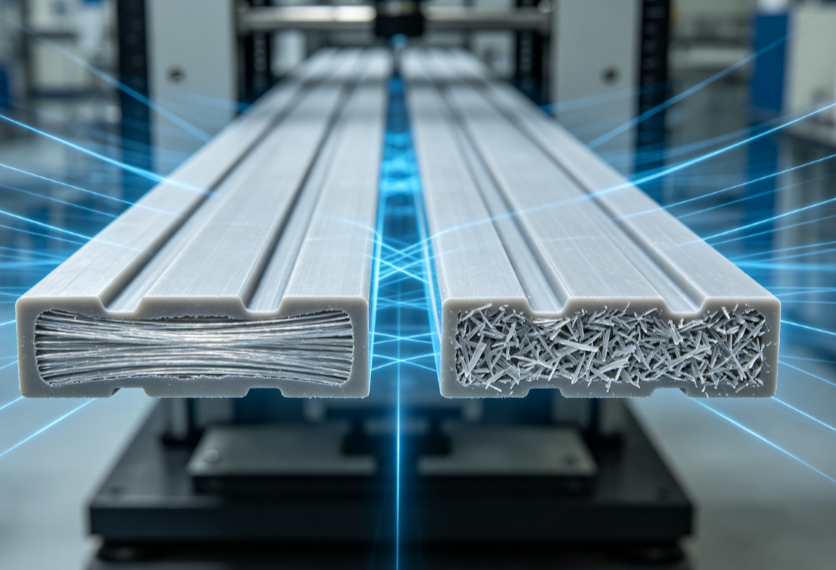
Short glass fiber reinforced ABS is produced by introducing pre-chopped short fibers—typically no longer than 1 mm—into an extruder, where they are mixed with the ABS polymer and other additives. The fibers are randomly oriented within the pellets and vary in length.
Key characteristics:
Property | Description |
Fiber length | Typically < 0.5 mm |
Fiber orientation | Randomly distributed within pellets |
Processing method | Conventional compounding and pelletizing |
Long Glass Fiber Reinforced ABS (LGF-ABS)
Long glass fiber reinforced ABS is produced through a pultrusion process, where continuous fiber strands are drawn through an impregnation die with the polymer, then cut to length—typically 12 mm—to form pellets. The fibers within each pellet are parallel to one another and match the pellet length.
Key characteristics:
Property | Description |
Fiber length | Typically > 5 mm (usually 5–25 mm) |
Fiber orientation | Parallel-aligned within pellets |
Processing method | Pultrusion compounding and pelletizing |
This difference in fiber length has profound implications for mechanical performance, which we'll explore in detail below.
The Real Difference Lies in the Fiber Network Structure
The fundamental distinction between long-fiber and short-fiber materials isn't just fiber length—it's the fiber network structure that forms during the injection molding process.
How Short Fibers Behave
In short glass fiber reinforced ABS, the short glass fibers are randomly oriented and relatively isolated within the polymer matrix. When the material is stressed, loads are transferred from the matrix to individual fibers. Because the fibers are short, they can only bridge short distances, limiting the reinforcement effect.
In pyrolysis studies—where the polymer is burned away to examine the remaining fiber structure—short-fiber parts collapse on themselves. This indicates that short fibers cannot form a coherent load-bearing network.
How Long Fibers Behave
During the injection molding process, long glass fiber bundles longer than 5 mm become fully wet out and dispersed within the molten ABS resin. Guided by the high-pressure flow within the mold cavity, these long fibers intertwine and interlock with one another, eventually cooling and solidifying into a three-dimensional continuous fiber network skeleton.
Think of it like reinforced concrete: short fibers are like scattered rebar segments, providing localized reinforcement; long fibers form a continuous rebar mesh that distributes loads throughout the entire structure.
This skeletal structure enables efficient load transfer, giving long-fiber thermoplastics a clear advantage over their short-fiber counterparts. After pyrolysis, long-fiber parts retain their shape, while short-fiber parts collapse.
Mechanical Property Comparison
Here's what the data actually shows.
Tensile Strength
Short Glass Fiber Reinforced ABS: A study on 3D-printed ABS with 30% short glass fiber reinforcement showed a peak ultimate tensile strength of 49.7 MPa. This represents a 57% improvement over neat ABS.
Long Glass Fiber Reinforced ABS: A 40% long glass fiber reinforced ABS grade achieved a tensile strength at break of 110 MPa. At comparable fiber loadings, this is more than double the strength of short glass fiber reinforced ABS.
More significantly, 30% fiber loading LGF-ABS typically reaches 110–130 MPa tensile strength, while 30% SGF-ABS tops out at around only 50–60 MPa.
Flexural Modulus
Short Glass Fiber Reinforced ABS: Flexural modulus increases with fiber content, but to a relatively limited extent.
Long Glass Fiber Reinforced ABS: A 40% long glass fiber reinforced ABS grade achieves a flexural modulus of 7,590 MPa. This exceptional rigidity makes LGF-ABS suitable for semi-structural applications requiring high stiffness.
Impact Resistance
This is where long glass fiber reinforced ABS truly excels.
Short Glass Fiber Reinforced ABS: Increasing short glass fiber content actually reduces impact strength. The composite with 30% short fibers exhibits the lowest flexibility due to restricted polymer chain mobility.
Long Glass Fiber Reinforced ABS: Long glass fibers dramatically improve impact performance. The continuous fiber network absorbs and dissipates impact energy over a wider area, providing excellent toughness and resistance to impact and fatigue. LGF-ABS offers 1–3 times higher toughness compared to short-fiber materials.
Creep and Fatigue Resistance
Long fibers perform significantly better under sustained and cyclic loading.
Short Glass Fiber Reinforced ABS: Moderate creep resistance; limited fatigue stability.
Long Glass Fiber Reinforced ABS: Under sustained static loads (creep) or cyclic loading (fatigue), the internal fiber skeleton provides critical load-bearing support, significantly slowing the plastic matrix's tendency toward plastic deformation. LGF-ABS exhibits excellent creep resistance and superior fatigue performance.
Dimensional Stability
Short Glass Fiber Reinforced ABS: Good dimensional stability.
Long Glass Fiber Reinforced ABS: Long glass fibers have an extremely low coefficient of thermal expansion. When they form a network skeleton within the ABS matrix, they effectively constrain the matrix's thermal expansion and contraction behavior. As a result, LGF-ABS offers very low linear thermal expansion coefficients and molding shrinkage.
Anisotropy
Short Glass Fiber Reinforced ABS: Short-fiber materials exhibit higher strength in the flow direction but weaker strength perpendicular to it. This anisotropy can create weak points in the part.
Long Glass Fiber Reinforced ABS: The three-dimensional fiber network reduces anisotropy, providing more uniform strength in all directions.
Performance Comparison Summary Table
Property | Short Glass Fiber ABS | Long Glass Fiber ABS |
Fiber length | < 0.5 mm | > 5 mm (5–25 mm) |
Tensile strength | ~50 MPa (30% fiber) | 110–130 MPa (30–40% fiber) |
Flexural modulus | Moderate | Up to 7,590 MPa |
Impact resistance | Decreases with fiber content | 1–3× higher than short fiber |
Creep resistance | Moderate | Excellent |
Fatigue resistance | Limited | Superior |
Dimensional stability | Good | Excellent |
Surface finish | Smoother | Rougher (can be optimized) |
Cost | Lower | Higher (but better cost-performance ratio) |
When to Choose Which Material
Choose Short Glass Fiber Reinforced ABS When:
Cost is the primary concern. SGF-ABS is more economical.
Surface finish matters. Short-fiber materials provide a smoother surface.
The part is not load-bearing. For non-structural or light-duty applications, SGF-ABS may be sufficient.
Good processability is needed. SGF-ABS is easier to injection mold.
The part has complex geometry. Shorter fibers flow more easily into tight spaces.
Choose Long Glass Fiber Reinforced ABS When:
Maximum strength and stiffness are required. LGF-ABS delivers significantly higher tensile strength and flexural modulus.
The part will endure impact loads. LGF-ABS is 1–3 times tougher than SGF-ABS.
The part must withstand sustained or cyclic loads. Creep and fatigue resistance are excellent.
Dimensional stability is critical. LGF-ABS minimizes warpage and shrinkage.
You are replacing metal. LGF-ABS is the material of choice for metal replacement applications.
Real-World Application Examples
LGF-ABS in Automotive: BMW Dashboard Carrier
One of the most compelling examples of long glass fiber reinforced ABS capability is its use in the dashboard carrier of the new BMW 3 Series. This component was originally produced as a magnesium die-casting. Magnesium is significantly stiffer than plastic, so the polymer part had to be fully ribbed to achieve comparable performance.
The result was a weight-optimized part solution that not only replaced magnesium but also offered lower shrinkage, less warpage, high stiffness at elevated temperatures, and a low coefficient of thermal expansion. The LGF-ABS solution achieved a 30% weight reduction compared to aluminum or magnesium.
This isn't a niche application. LGF-ABS is now widely used in automotive instrument panel assemblies, integrating functional structures such as instrument mounting brackets, HVAC ducts, defroster grilles, and airbag brackets into a single part. Compared to traditional steel carriers, LGF-ABS not only achieves weight reduction but also significantly simplifies the supply chain and assembly processes.
Other Applications
Long glass fiber reinforced ABS is well-suited for:
Power tool housings – Excellent impact resistance and durability under mechanical stress
Industrial machinery parts – Brackets, covers, and support frames requiring long service life and fatigue resistance
Electric vehicle components – Motor mounts and electronic housings requiring high strength-to-weight ratios
Electronic equipment structural parts – Thermal management components and structural enclosures
Cost-Benefit Analysis
Long glass fiber reinforced ABS is more expensive than short glass fiber reinforced ABS. However, its superior cost-performance ratio makes it attractive for applications requiring engineered material solutions.
Consider this: A part using short glass fiber reinforced ABS may fail over time under impact or creep, leading to warranty claims, replacements, and reputational damage. LGF-ABS has a higher upfront cost but delivers performance that short-fiber materials simply cannot achieve.
Frequently Asked Questions
Q: What is the main difference between long and short glass fiber reinforced ABS?
A: The key difference lies in fiber length. Short glass fibers are typically less than 0.5 mm, while long glass fibers exceed 5 mm (typically 5–25 mm). This length difference enables long fibers to form a continuous three-dimensional reinforcing network within the part.
Q: Which is stronger: long glass fiber or short glass fiber reinforced ABS?
A: Long glass fiber reinforced ABS is significantly stronger. A 40% LGF-ABS grade achieves a tensile strength of 110 MPa, while a 30% SGF-ABS typically reaches only about 50 MPa.
Q: Does long glass fiber reinforced ABS have better impact resistance?
A: Yes. Long fibers dramatically improve impact performance. LGF-ABS offers 1–3 times higher toughness compared to short-fiber materials.
Q: Is long glass fiber reinforced ABS more expensive?
A: Yes, LGF-ABS is somewhat more expensive. However, it offers a superior cost-performance advantage for demanding applications.
Q: Which material has a better surface finish?
A: Short glass fiber reinforced ABS provides a smoother surface. LGF-ABS surface finish can be optimized but is generally rougher.
Q: Can long glass fiber reinforced ABS replace metal?
A: Yes. LGF-ABS has been successfully used to replace magnesium in automotive dashboard carriers, achieving a 30% weight reduction compared to aluminum or magnesium.
Summary
The difference between long glass fiber reinforced ABS and short glass fiber reinforced ABS isn't just about fiber length—it's about fundamentally different material behavior. Short fibers provide localized reinforcement but remain isolated within the matrix. Long fibers intertwine and interlock, forming a continuous three-dimensional network that distributes loads throughout the entire part.
Choose short glass fiber reinforced ABS when cost is the primary constraint and your application doesn't require maximum strength, impact resistance, or dimensional stability. Choose long glass fiber reinforced ABS when you need engineering-grade performance—when parts must withstand impacts, endure loads over time, hold tight tolerances, or replace metal.
The data is clear: Long glass fiber reinforced ABS is superior in mechanical strength, impact resistance, creep resistance, fatigue resistance, and dimensional stability. The higher upfront cost is justified by performance that short-fiber materials simply cannot match