
1. Introduction
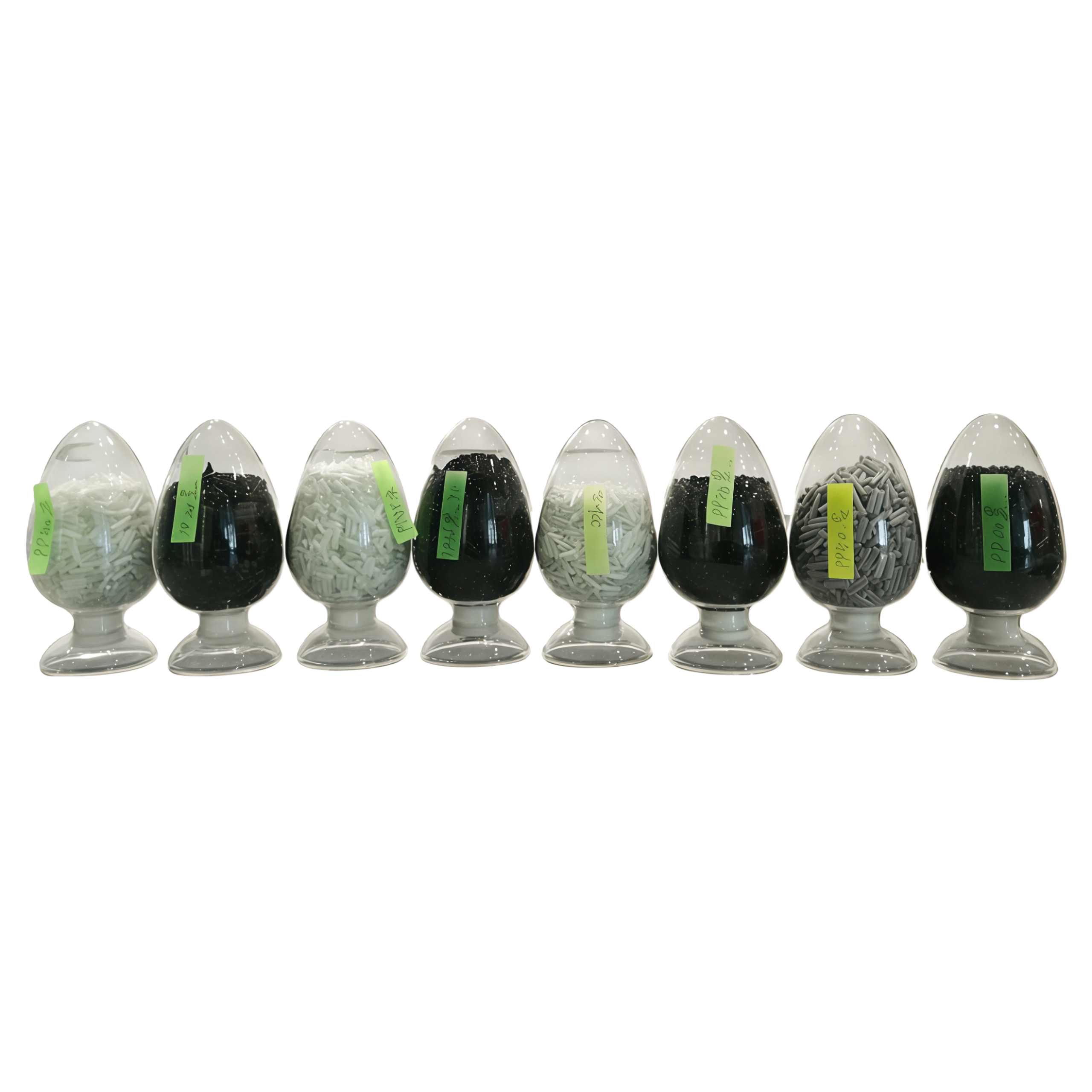
Long glass fiber reinforced polyamide (LGF-PA) has become a go-to material for engineers who need structural performance at a reasonable weight. It bridges the gap between standard engineering plastics and metal. The long fibers—typically 10 to 25mm in length—create a three-dimensional reinforcing network that transfers load efficiently, absorbs impact energy, and resists deformation under sustained stress.
This review examines the mechanical properties that define LGF-PA: tensile strength, flexural strength, impact resistance, and stiffness. We'll look at how fiber content affects performance, what the data actually shows, and how the material behaves under real-world conditions.
2. Strength – Tensile and Flexural Performance
Tensile and flexural strength are the most commonly quoted specifications for LGF-PA. The data varies significantly depending on the specific grade, fiber content, and test method.
Tensile strength for 30% long glass fiber reinforced PA6 typically ranges from 180 to 260 MPa. A PA6-LGF30 grade shows a yield stress of 185 MPa with a tensile modulus of 10,500 MPa . Moving to a PA66-LGF30 with additional carbon fiber reinforcement, tensile strength reaches 252 MPa with a modulus of 17,240 MPa . For higher loadings, a 60% LGF-PA6 compound achieves tensile strength of 255 MPa and a tensile modulus of 20.0 GPa .
Flexural strength tells you how the material resists bending. The same PA6-LGF30 grade shows flexural strength of 260 MPa with a flexural modulus of 10,200 MPa . The PA66 hybrid grade achieves 338 MPa flexural strength with a flexural modulus of 17,930 MPa . At 60% fiber loading, flexural strength reaches 407 MPa with a flexural modulus of 17.24 GPa .
Elongation at break is typically low, ranging from 1.0% to 2.5% . This reflects the material's stiff, brittle behavior under tensile load—the fibers restrict plastic deformation.
3. Impact Resistance – Energy Absorption and Toughness
Impact resistance is where LGF-PA excels compared to short-fiber alternatives. The long fibers bridge crack paths and dissipate energy effectively.
Charpy notched impact strength for PA6-LGF30 at 23°C is approximately 17 kJ/m², dropping to about 16 kJ/m² at -30°C . The un-notched impact strength is significantly higher—55 kJ/m² at 23°C—indicating the material performs well when there's no stress concentrator.
Izod impact values vary with test method. A PA66-LGF30 compound shows notched Izod impact of 320 J/m and unnotched of 854 J/m (ASTM D-256) . At 60% fiber loading, notched Izod reaches 3.20 J/cm, with unnotched impact of 12.8 J/cm . The 50% LGF-PA6 compound from RTP Company shows similar notched Izod values of 3.20 J/cm .
The critical difference: LGF-PA absorbs impact energy through fiber pull-out and debonding mechanisms. The long fibers pull out of the matrix during impact, absorbing energy and preventing catastrophic failure. This is why LGF-PA outperforms short-fiber compounds in demanding applications like automotive structural parts.
4. Stiffness – Modulus and Dimensional Stability
Stiffness is measured by the tensile modulus (Young's modulus) and flexural modulus. Higher values mean the material resists deformation under load.
Tensile modulus for PA6-LGF30 is approximately 10,500 MPa . The PA66 hybrid with carbon fiber reaches 17,240 MPa . At 60% fiber loading, tensile modulus reaches 20.0 GPa . For comparison, a 20% LGF-PA66 compound shows tensile modulus of 10,345 MPa .
Flexural modulus follows similar trends. PA6-LGF30 shows 10,200 MPa ; the PA66 hybrid shows 17,930 MPa ; 60% fiber loading gives 17.24 GPa ; and the 50% LGF-PA6 compound shows 16.5 GPa .
Water absorption affects stiffness. PA is hygroscopic. Material datasheets often report properties in both dry and conditioned states. A 50% GF-PA resin shows tensile strength of 230 MPa dry versus 175 MPa at 0.7% moisture . Moisture acts as a plasticizer, reducing modulus and strength while increasing elongation.
5. The Glass Fiber Loading Effect – How Content Changes Properties
The fiber fraction significantly affects mechanical performance. Here's how different loadings compare for PA66-based compounds:
Fiber Content | Tensile Strength (MPa) | Tensile Modulus (GPa) | Flexural Strength (MPa) | Flexural Modulus (GPa) | Notched Izod (J/m) |
20% LGF-PA66 | 117 | 10.3 | 193 | 5.5 | 214 |
30% LGF-PA66 hybrid | 252 | 17.2 | 338 | 17.9 | 320 |
60% LGF-PA6 | 255 | 20.0 | 407 | 17.2 | 320 |
A Fraunhofer study on PA6 LFT-D processed at fiber fractions from 20% to 60% reports that tensile stiffness and strength can reach 20 GPa and 229 MPa respectively, with flexural stiffness and strength at 17 GPa and 373 MPa . Impact toughness reaches 80 kJ/m².
The pattern: Increasing fiber content generally improves strength, stiffness, and impact resistance—up to a point. Beyond about 60% fiber loading, the matrix becomes insufficient to wet out and bond the fibers effectively, and properties may plateau or decline.
6. Thermal and Aging Considerations
LGF-PA doesn't exist in a vacuum. Real-world performance depends on temperature and aging conditions.
Heat deflection temperature (HDT). The PA66 hybrid with carbon fiber shows an HDT of 249°C at 264 psi (1.8 MPa) . The 60% LGF-PA6 compound shows 221°C . A PA6/SMA/LGF composite with 27% fiber content reaches an HDT of 206°C . These values indicate that LGF-PA maintains its stiffness at elevated temperatures far above standard unfilled PA.
Thermal-oxidative aging. A study on PA6/LGF composites at 160°C found that mechanical properties decrease due to molecular chain scission and debonding at the fiber-matrix interface . With antioxidant, tensile strength retention is 83.9%; without, it drops to 76.8% . Antioxidant addition significantly improves retention of mechanical properties.
Processing considerations. LGF-PA requires careful drying before molding. Moisture causes hydrolysis and property loss. Recommended pre-drying for PA66 compounds is 85°C for 4 hours, with processing humidity below 0.18% . Melt temperatures range from 293°C to 310°C depending on the grade .
7. Conclusion
Long glass fiber reinforced polyamide delivers a compelling combination of strength, impact resistance, and stiffness. The 30% LGF-PA grades offer tensile strengths around 185–260 MPa, flexural strengths of 260–338 MPa, and notched impact resistance of 17 kJ/m² or higher . Higher fiber loadings push these numbers further, with 60% LGF compounds achieving tensile strength above 250 MPa and flexural strength over 400 MPa .
The key advantage over short-fiber compounds is the three-dimensional fiber network, which absorbs impact energy through fiber pull-out rather than brittle fracture. This makes LGF-PA the preferred choice for structural and semi-structural applications in automotive, industrial, and consumer goods.
When specifying LGF-PA, consider the fiber fraction, the base PA type (PA6 vs. PA66), the processing method (injection molding vs. LFT-D), and the expected service temperature. And always check the property data for conditioned specimens—moisture absorption is real, and it changes the numbers.
8. Frequently Asked Questions (FAQ)
Q: What is the typical tensile strength of 30% long glass fiber reinforced PA?
A: For PA6-LGF30, tensile strength is typically 185–260 MPa . PA66-based grades can reach higher values, especially when combined with carbon fiber reinforcement .
Q: How does LGF-PA compare to short glass fiber reinforced PA?
A: LGF-PA offers significantly higher impact resistance, better creep resistance, and improved dimensional stability. The long fibers form a three-dimensional reinforcing network that short fibers cannot achieve. This makes LGF-PA more suitable for structural applications.
Q: What is the impact strength of LGF-PA?
A: Charpy notched impact for PA6-LGF30 is approximately 17 kJ/m² at 23°C . Izod notched impact for PA66-LGF30 is about 320 J/m . Values vary with fiber content—higher loadings generally increase impact resistance.
Q: Does moisture affect LGF-PA properties?
A: Yes. PA is hygroscopic. Moisture absorption acts as a plasticizer, reducing strength and modulus while increasing elongation. Material datasheets often report properties in both dry and conditioned states. A 50% GF-PA resin shows tensile strength of 230 MPa dry versus 175 MPa at 0.7% moisture .
Q: What are the processing requirements for LGF-PA?
A: LGF-PA must be dried before molding—typically 85°C for 4 hours for PA66 compounds, with processing humidity below 0.18% . Melt temperatures range from 293°C to 310°C. Proper drying prevents hydrolysis and property loss.
Q: How does thermal aging affect LGF-PA?
A: Thermal oxidation causes molecular chain scission and fiber-matrix debonding, reducing mechanical properties. A study at 160°C found that with antioxidant, tensile strength retention is 83.9%; without, it drops to 76.8% . Antioxidants significantly improve property retention.