In recent years, lightweighting, low carbon emissions and high performance have become the three core trends across manufacturing industries. Traditional metals feature high strength yet suffer from high density, high processing energy consumption and susceptibility to corrosion. While conventional short glass fiber reinforced plastics deliver notable weight reduction, they perform poorly under long-term load bearing, alternating high-low temperature cycles, and thin-wall high-rigidity service conditions.
Against this backdrop, Long Glass Fiber Reinforced Polypropylene (LGF-PP) and Long Glass Fiber Reinforced Polyamide 66 (LGF-PA66) have emerged as standout materials, ranking among the fastest-growing segments within the global modified plastics sector. Industry statistics show the global market for long glass fiber reinforced thermoplastic composites reached approximately USD 2.8 billion in 2023 and is projected to hit USD 4.5 billion by 2030, representing a compound annual growth rate (CAGR) of around 7.2%. This growth is primarily driven by lightweighting regulations and cost pressure.
1. Core Technical Advantages of Long Glass Fiber Reinforced Materials
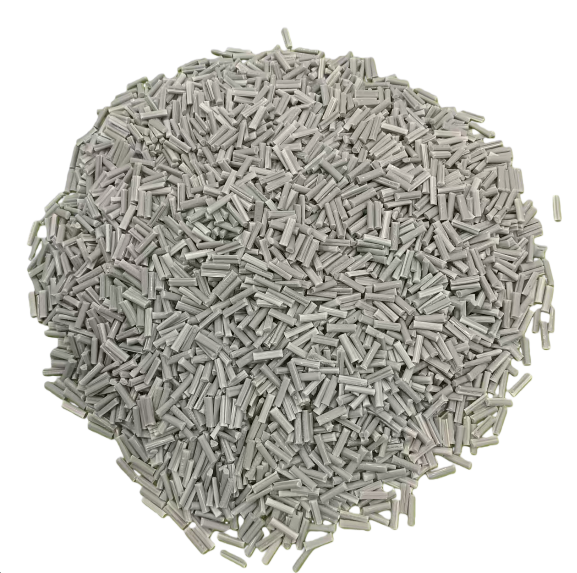
Conventional short glass fiber reinforced plastics typically contain fibers only 0.2–0.6 mm in length. By contrast, long glass fiber reinforced materials utilize specialized impregnation and extrusion processes to retain fiber lengths of 10–25 mm within the resin matrix, which form a three-dimensional interlocking network after injection molding. It should be noted that the integrity of this network structure depends on screw design and gate configuration during molding; improper processing can drastically reduce residual fiber length.
This unique microstructure delivers three major performance improvements:
1.1 Exceptional Impact Resistance
The interconnected long glass fiber network effectively blocks crack propagation, delivering 40%–80% higher notched impact strength than short-fiber PP/PA grades. Conventional plastics tend to suffer brittle fracture at -40°C, whereas long glass fiber materials retain over 80% of their room-temperature impact performance at such low temperatures. All above test data comply with ISO 179 and ASTM D256 standards.
1.2 Superior Creep Resistance & Dimensional Stability
Under sustained static load (e.g., automotive inner frames, home appliance support legs), short-fiber plastics undergo obvious creep deformation. The rigid glass fiber skeleton in long fiber grades cuts creep rates by more than 50%. Furthermore, in alternating temperature cycling tests ranging from -40°C to 120°C, warpage of long glass fiber molded parts is only roughly one-third that of short-fiber counterparts. This characteristic makes LGF materials ideal for components exposed to wide outdoor temperature fluctuations.
1.3 Balanced High Strength & Lightweight Performance
LGF-PP has a density of 1.0–1.2 g/cm³, and LGF-PA66 ranges from 1.3–1.5 g/cm³—just 1/2 to 1/3 the density of aluminum alloy. However, its specific strength (strength-to-density ratio) matches or even exceeds certain aluminum alloys, making it an optimal candidate for metal replacement. For instance, LGF-PP40 achieves tensile strength of 120–150 MPa and flexural modulus of 10–12 GPa, sufficient to replace metal for most semi-structural components.
2. Typical Application Segments & Corresponding Material Requirements
表格
Industry | Component Examples | Core Performance Requirements | Recommended Materials |
Automotive | Door inner frames, sunroof rails, underbody shields, pedal brackets | Low-temperature impact resistance at -40°C, long-term vibration resistance, flame retardancy | LGF-PP20~40 |
Automotive | Engine decorative covers, intake manifolds, fan blades | 120°C heat resistance, oil resistance, low odor | LGF-PA66 30~40 |
Home Appliances | Washing machine balance rings, air conditioner fan brackets, dishwasher pump housings | Hydrolysis resistance, detergent resistance, stable dimensional performance | LGF-PP for non-high-temperature zones; LGF-PA66 for high-temperature/humid environments |
Construction Machinery | Hydraulic pump housings, agricultural machinery frames, excavator covers | High load capacity, oil resistance, weather resistance | LGF-PA66 40~50 |
New Energy Vehicles & Energy Storage | Battery brackets, charging pile housings, energy storage enclosures | UL94 V-0 flame retardancy, weather resistance, electrical insulation | Halogen-free flame-retardant LGF-PP; LGF-PA66 for higher temperature exposure |
Note: For cost-sensitive home appliance components, LGF-PP is the preferred option. LGF-PA66 is specified for parts requiring a high heat deflection temperature (HDT > 200°C) or superior chemical resistance.
3. Market Trend Data
Third-party research reports (including MarketsandMarkets) indicate the global long glass fiber reinforced thermoplastic composite market stood at USD 2.8 billion in 2023, with a projected value of USD 4.5 billion by 2030 and a CAGR of 7.2%. The Asia-Pacific region records the fastest growth rate. As a major manufacturer and exporter of modified plastics, China is gradually substituting high-cost European and American imported materials. The key growth drivers are a 20%–30% cost advantage and shorter production lead times.
4. Our Corporate Positioning
Our company boasts over 20 years of dedicated R&D and manufacturing experience for LGF-PP and LGF-PA66, with an independent proprietary continuous long glass fiber impregnation production process. Our products are exported in bulk to Europe, Russia, Southeast Asia, the Middle East, South America and other regions.
We do not claim to be the sole or top supplier; instead, we provide fully validated alternative material solutions. Compared with leading European and American brands such as SABIC, Celanese and DSM, our materials deliver a 20%–25% cost reduction while retaining 85%–95% of their mechanical performance, verified through mass production trials with multiple clients.
Beyond standard grades, we develop custom-formulated materials tailored to clients’ operating environments (extreme high/low temperatures, high humidity, oil contamination, long-term outdoor UV exposure). We help customers slash material costs while guaranteeing target performance. Practical production experience shows custom formula development, adjustment and sample validation typically take 4–6 weeks before mass production launch.